HVAC Trouble Guide
AC Compressor Not Working but Fan Is Running? 7 Causes and Fixes
When the outdoor fan spins but the compressor stays quiet, the run capacitor is the most common reason. On most units one dual capacitor powers both the fan and the compressor, and the compressor side often fails first. Other causes are a compressor that shut off on its thermal overload, a burnt wire or contactor, low refrigerant, or a compressor that has failed.
Tools you'll need
- Flashlight
- Nut driver (1/4" and 5/16")
- Insulated screwdriver
- Multimeter with a capacitance (µF) setting
- Your phone, to photo the wiring before you touch it
Typical cost
A new compressor usually runs $1,500–$3,500 or more installed. Prices are rough and vary by area, brand and season.
On this page
Safety: turn off the unit and the breaker before removing any panel. If you smell gas, stop, leave the house and call your gas company from outside. Refrigerant, gas valve and high-voltage repairs need a licensed technician.
It’s hot, the AC is on, and you can hear the fan outside spinning away. But the air coming out of the vents is warm, and when you stand next to the outdoor unit there’s no deep hum from the compressor. Just the fan.
This one is common, and it’s often cheap to fix. The part that fails most is a $20 capacitor. We’ll go through the checks in the order we’d do them: easy look-and-listen stuff first, then the parts, then the things that need a technician.
Which fan is running?
Before anything else, go outside and check which fan you’re actually hearing. It changes everything.
- The fan on top of the outdoor unit is spinning, but no compressor hum. This guide is for you. Power is reaching the unit, so the problem is inside it.
- Only the indoor fan is running and the outdoor unit is completely silent. The outdoor unit isn’t getting the signal or the power to start. Jump to Cause 2 and check the breaker and disconnect first.
- You have a split or ductless unit (the head on the wall inside). Read the split and ductless section too. They have a few causes of their own.
Also, give it a few minutes. Most systems have a built-in delay of 3 to 5 minutes before the compressor is allowed to restart. If you just turned it on, or someone bumped the thermostat, wait five minutes before you decide anything is wrong.
How your AC starts the compressor
When the thermostat calls for cooling, a chain of things has to happen in order. If any link breaks, the compressor stays off, even though the fan might still run.
- The thermostat sends a 24-volt signal to the outdoor unit.
- The contactor (a switch inside the outdoor unit) pulls in and sends 240 volts to the fan and the compressor.
- The capacitor gives the compressor motor the extra push it needs to start turning.
- The compressor starts and begins pumping refrigerant.
- A safety inside the compressor, called the thermal overload, stays closed as long as the compressor isn’t overheating.
- Refrigerant flows through the system, and the indoor coil gets cold.
On most central AC units, the fan and the compressor are switched by the same contactor. So if the outdoor fan is running, the contactor has usually done its job, and the trouble is somewhere after it.
Quick symptom guide
| What you notice | Most likely cause |
|---|---|
| Fan runs, compressor totally silent | Bad capacitor (compressor side), tripped overload, or a loose wire → |
| Fan runs, compressor hums or buzzes but doesn’t start | Bad capacitor, or a compressor that needs a hard start kit → |
| Compressor clicks on and off every few minutes | Overheating (dirty coil, low refrigerant) or a weak capacitor → |
| Compressor ran fine, then quit on a very hot afternoon | Thermal overload trip → |
| Top of the capacitor is bulged or leaking oil | Capacitor has failed → |
| Burnt smell, melted wire or black marks in the panel | Burnt wiring or contactor → |
| Breaker trips the moment the compressor tries to start | Shorted compressor or wiring, call a pro → |
| Indoor fan runs, outdoor unit completely dead | No power or no signal to the outdoor unit → |
Cause 1: A weak or dead capacitor
This is the big one. If we had to bet on a single part, this is it.
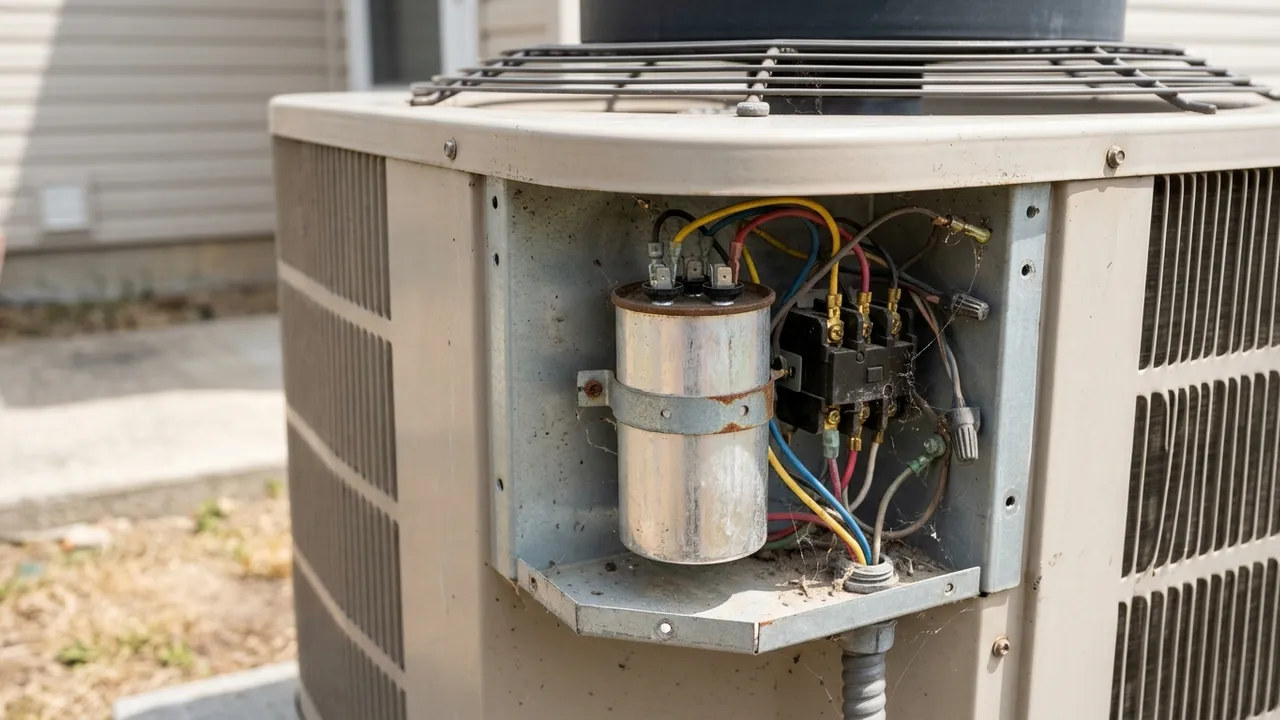
Most outdoor units have one silver can with three terminals on top, marked C, HERM and FAN. That’s a dual run capacitor. The HERM side runs the compressor (HERM is short for hermetic, the sealed compressor), and the FAN side runs the fan motor. It’s very common for the HERM side to fail while the FAN side still works fine, which gives you exactly this problem: fan spinning, compressor dead.
How to check it:
- Kill the power at the disconnect and the breaker.
- Take off the electrical access panel on the outdoor unit. It’s usually a small panel near where the power lines come in, held by two or three screws.
- Look at the capacitor. A bulged or domed top, a split case, or oily residue means it’s done. But plenty of bad capacitors look perfectly normal.
- Take a photo of the wiring so you know where everything goes.
- If you have a meter with a µF setting, discharge the capacitor first by touching an insulated screwdriver across C and HERM, then C and FAN. Then pull the wires and test C to HERM and C to FAN.
- Compare your readings with the rating printed on the label, for example 45/5 µF. Most capacitors are rated ±6%. If a 45 µF side reads under about 42, replace it.
When you buy a new one, match the µF ratings exactly and use the same voltage or higher (370 V or 440 V). A 440 V capacitor can replace a 370 V one, but not the other way round. The physical size only matters for fitting the mounting bracket.
Call a technician if: you don’t own a meter with a capacitance setting, or you aren’t comfortable working around 240 volts. A capacitor swap is a short visit for a tech, and many carry the common sizes on the truck.
Cause 2: The contactor isn’t pulling in
The contactor is the black block with wires going in and out, usually right next to the capacitor. When the thermostat calls for cooling, a small coil inside pulls the contacts closed and sends 240 volts out to the fan and the compressor.
If the outdoor fan is running, the contactor is almost always pulling in. But not always fully. Contacts get pitted and burnt over the years, and one side can stop passing power to the compressor even while the fan still gets it. Some units also use a single-pole contactor, where one leg of power is always live.
What to look for (power off):
- Burnt, black or pitted contact points. You can usually see them through the sides.
- Melted or discolored wire ends on the contactor terminals.
- Ants or bugs packed inside. It sounds odd, but ants are drawn to the electric field and can jam the contacts open. It happens a lot in the South.
If the whole outdoor unit is silent (only the indoor fan runs), check the obvious things first: the AC breaker, the outdoor disconnect, and the thermostat set to Cool and a few degrees below room temperature. Many indoor units also have a float switch on the condensate drain that cuts the signal to the outdoor unit if the drain backs up.
A replacement contactor is cheap, usually $20 to $50, and swaps wire for wire. Match the coil voltage (24 V on nearly every home unit) and the amp rating.
Call a technician if: the contactor or its wires look burnt. Burnt contacts are often a sign something else is drawing too much current, and you want that found, not just the contactor replaced.
Cause 3: The compressor is too hot (thermal overload)
Every home AC compressor has a safety built into it that shuts it off when it overheats. When that overload trips, the fan keeps running but the compressor goes quiet. The overload resets by itself, but only once the compressor cools down, and that can take an hour or more.
You’ll often notice this on the hottest afternoons. The AC works in the morning, then quits around 3 p.m.
Why compressors overheat:
- A dirty outdoor coil. Look at the fins around the sides of the unit. If they’re matted with grass clippings, cottonwood fluff or dirt, the heat can’t get out. Shut off the power and rinse the coil gently from the inside out with a garden hose. No pressure washer.
- Blocked airflow. Bushes, a fence, or stuff stored right up against the unit. Give it at least two feet of clear space on every side.
- A weak capacitor. See Cause 1. A tired capacitor makes the compressor draw more current and run hot.
- Low refrigerant. See Cause 6. The compressor is cooled by the refrigerant coming back to it, so a low charge makes it overheat.
If you think it tripped, turn the system off at the thermostat, clean the coil, and wait at least an hour before you try again. If it runs for a while and then trips again, the overheating has a cause that needs finding.
Call a technician if: the compressor trips again after the coil is clean and the capacitor tests good. Repeated trips wear out the compressor.
Cause 4: Loose or burnt wiring
The outdoor unit sits out in the weather, shakes every time it starts, and gets baked all summer. Wires work loose, terminals corrode, and connectors burn.
With the power off, look over everything in the electrical panel:
- Spade connectors on the capacitor that have slipped loose.
- Wires with melted or cracked insulation.
- Brown or black marks around a terminal.
- The wires going to the compressor. They usually run through a small cover on the side of the compressor itself. A burnt terminal there means the compressor can’t get power at all.
Small loose connectors can be pushed back on firmly or replaced. If a wire is burnt, it needs to be cut back to clean copper and given a new terminal of the right size.
Call a technician if: the burnt wiring is at the compressor terminals. Those terminals are sealed into the compressor, and a damaged one can leak refrigerant and oil if it’s handled wrong.
Cause 5: The compressor hums but won’t start
If you hear a loud hum or buzz from the outdoor unit for a few seconds, then a click, and the compressor never gets going, it’s trying to start and can’t. The click is usually the overload cutting it off.
The most common reason is still the capacitor. Check Cause 1 first.
If the capacitor is good, the compressor may be “hard starting.” Older compressors get harder to turn over, especially after the system has been off for a while or when it tries to start against high pressure. A hard start kit is a small add-on capacitor and relay that gives the compressor a much bigger kick for a split second. They cost about $25 to $50 and often get an aging compressor going again for years.
A compressor that’s mechanically locked up, called “locked rotor,” won’t start even with a hard start kit. At that point the compressor has failed.
Call a technician if: the compressor keeps humming and tripping after a new capacitor. Don’t keep resetting it. Every failed start is hard on the motor windings.
Cause 6: Low refrigerant
A lot of outdoor units have a low-pressure switch that shuts off the compressor when the refrigerant gets too low. The fan may keep running, or the system may short-cycle on and off.
Signs your refrigerant is low:
- Ice on the copper line going into the outdoor unit, or on the indoor coil.
- A hissing or bubbling sound near the lines.
- The AC has been cooling worse and worse over the past few weeks before it quit.
- Oily spots on the copper lines or fittings, where refrigerant and oil have leaked out.
Refrigerant doesn’t get “used up.” If it’s low, there’s a leak. Adding refrigerant without fixing the leak just buys a few weeks. And only a licensed technician can legally handle it.
Call a technician if: you see ice or suspect a leak. Turn the system off and let any ice melt before it runs again.
Cause 7: The compressor has failed
If the capacitor is good, the wiring is clean, the contactor is passing power, and the compressor still won’t run (or it trips the breaker the second it tries), the compressor itself has likely failed.
A technician will check the compressor windings with a meter. They’re looking for an open winding (no connection), a short between windings, or a winding shorted to the metal case. A compressor that’s “grounded” like that will trip the breaker every time.
This is the expensive one. Before you agree to a new compressor, ask:
- Is the unit still under the parts warranty? Many compressors carry a 10-year parts warranty if the system was registered. Labor is usually extra.
- How old is the system? If it’s past 12 to 15 years, see Repair or replace? below.
Split and ductless AC: compressor not working but fan is running
If you have a split or ductless mini-split, with a head on the wall inside and a small outdoor unit, a few things work differently.
- Check the mode. It sounds silly, but this is one of the most common calls. In Fan mode, the indoor fan runs and the outdoor unit does nothing. In Dry mode the compressor may cycle on only now and then. Set it to Cool and pick a temperature a few degrees below the room.
- Give it time. Inverter units ramp up slowly and have a start delay of up to 3 to 5 minutes. The outdoor fan might even start before the compressor.
- Look for an error code. Most indoor units show a code on the display or blink a light pattern when something’s wrong. Write it down and look it up in the manual. It will often point straight at a sensor, a communication fault or an outdoor board problem.
- Clean the filters. Badly clogged indoor filters can make the indoor coil freeze, and the unit will shut the compressor off to protect itself.
- Power-cycle it. Turn the unit off, switch off the breaker for five minutes, then back on. This clears many board faults on inverter units.
Inverter compressors don’t use a run capacitor the way regular ones do. They’re driven by a circuit board in the outdoor unit. So if a mini-split’s compressor won’t start, the problem is more often a sensor, the board, or low refrigerant than a capacitor. Most of those repairs need a technician who works on your brand.
Call a technician if: the error code comes back after a power reset, or the outdoor unit makes no sound at all.
What to do in order (summary)
- Check which fan is running, and wait 5 minutes for the start delay.
- Thermostat on Cool, set below room temperature. Split units: not in Fan or Dry mode.
- Breaker and outdoor disconnect on.
- Power off, open the panel, look for a bulged capacitor.
- Look for burnt wires, loose spade connectors and a pitted contactor.
- Clean the outdoor coil and clear space around the unit.
- Test the capacitor with a meter, or call a pro.
- Ice on the lines? Turn it off and call for a leak check.
Repair or replace?
A capacitor, contactor or hard start kit is always worth fixing. They’re cheap and fast.
A failed compressor is a real decision. As a rough guide:
- Under 10 years old and under warranty: replacing the compressor usually makes sense.
- 10 to 15 years old: get a quote for both, and think about how much longer the rest of the system will last.
- Over 15 years old, or the unit uses R-22 (older “Freon”): replacing the whole system is usually the better money. R-22 is no longer made and is very expensive to buy.
A common rule of thumb: multiply the age of the unit by the repair cost. If the number is over $5,000, replacement tends to be the better deal.
When to call a technician
Call a licensed HVAC technician if the compressor hums and won’t start after a new capacitor, if the breaker trips when the compressor tries to start, if you see ice or oil on the refrigerant lines, if you find burnt wiring at the compressor, or if you’d simply rather not work around 240 volts. There’s no shame in that last one. Capacitors can bite even with the power off.
When you call, tell them what you’ve already checked: “The outdoor fan runs, the compressor doesn’t, the capacitor looks fine, and the coil is clean.” It saves them time, and it saves you money on the visit.
Frequently asked questions
Why is my AC fan running but not the compressor?
Nine times out of ten it's the run capacitor. The fan and the compressor usually share one dual capacitor, and the compressor side can die while the fan side keeps working. A thermal overload trip, a bad wire, low refrigerant or a failed compressor are the other usual causes.
How long can I run the AC with the fan on but the compressor off?
Turn it off. The fan alone won't cool anything, and if the compressor is humming while it tries to start, it's pulling heavy current and getting hot every time. Leave it off until you've found the problem.
Can a bad capacitor ruin the compressor?
Yes, over time. A weak capacitor makes the compressor struggle to start and run hot. Replace it as soon as you find it. It's one of the cheapest parts in the whole system.
How do I reset my AC compressor?
There's no reset button on most home compressors. Turn the thermostat off, switch off the breaker for the outdoor unit for about five minutes, then turn it back on. If the compressor had tripped on heat, give it 30 to 60 minutes to cool before you try again.
Is it worth replacing a compressor in an old AC?
If the system is over 12 to 15 years old, or uses R-22 refrigerant, a compressor replacement usually costs too close to a new system to make sense. On a unit still under its parts warranty, replacing just the compressor is often worth it.
Did this guide fix your problem?
One tap helps us improve this guide for the next person.
Free maintenance reminders
Get a short email before summer and winter: filter changes, pre-season checks, and the problems to watch for. About 4 emails a year.