HVAC Trouble Guide
Furnace Inducer Motor Not Turning On? 8 Causes and How to Fix Them
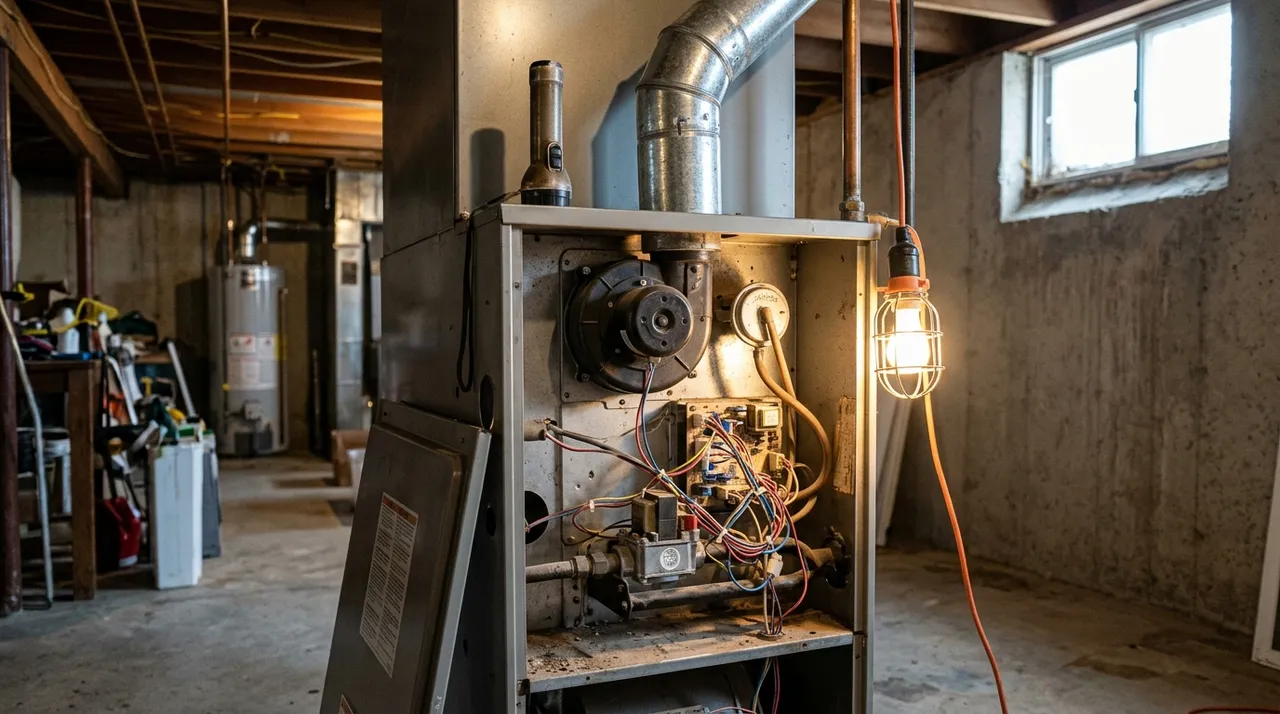
When the inducer motor won't start, the furnace is usually not getting a call for heat, has lost power (service switch, breaker, door switch or the small fuse on the control board), or the pressure switch is stuck closed. If all of those check out, the motor itself has seized or the control board isn't sending it power.
Tools you'll need
- Flashlight
- Screwdriver (Phillips and 1/4" nut driver)
- Multimeter (only for the voltage test)
- Spare 3 A or 5 A automotive fuse
Typical cost
A replacement inducer motor alone is usually $150–$500 depending on brand. Prices vary by area.
On this page
Safety: turn off the unit and the breaker before removing any panel. If you smell gas, stop, leave the house and call your gas company from outside. Refrigerant, gas valve and high-voltage repairs need a licensed technician.
You turn the heat up, wait, and nothing happens. No hum from the furnace, no click, no warm air. If you open the front panel and look at the little motor near the flue pipe, it isn’t moving either.
That little motor is the inducer, and when it doesn’t start, the whole heating cycle stops right there. The good news is that a lot of the reasons it won’t run are simple things you can check yourself in about 20 minutes.
We’ve put the checks in the order we’d do them ourselves: quickest and cheapest first, parts replacement last.
What the inducer motor does
On most gas furnaces built in the last 25 years or so, the inducer (some people call it the draft motor or draft fan) is the first thing that runs when the thermostat calls for heat. Here’s the normal startup order:
- The thermostat calls for heat.
- The control board runs a quick self-check, then sends power to the inducer motor.
- The inducer pulls air through the heat exchanger and pushes it out the flue pipe.
- A pressure switch senses that airflow and closes.
- The igniter heats up, the gas valve opens, and the burners light.
- After a short delay, the main blower kicks on and warm air comes out of the vents.
If step 2 or 3 never happens, nothing after it can happen either. So when we say “the inducer won’t turn on,” we really mean one of three things: the board never got the signal, the board got it but isn’t sending power, or the motor got power and can’t spin.
Quick symptom guide
| What you notice | Most likely cause |
|---|---|
| Totally silent, no lights on the board | No power: switch, breaker, door switch or board fuse → |
| Board light is on, but no click and no motor | No call for heat, or pressure switch stuck closed → |
| You hear a click, then nothing | Board relay or loose wiring to the motor → |
| Motor hums but doesn’t spin | Seized bearings or failed capacitor → |
| Motor starts after you tap it or give it a spin | Worn bearings, motor is failing → |
| Motor runs, then stops after a few minutes | Overheating motor or a blocked vent (a different problem) → |
Cause 1: The thermostat isn’t calling for heat
It sounds too obvious, but a lot of service calls end right here.
- Make sure the thermostat is set to Heat, not Cool, Off or Fan.
- Set the temperature at least 5 °F above what the room is now.
- If the screen is blank or dim, replace the batteries.
- Give it a few minutes. Many thermostats and boards have a built-in delay of 2 to 5 minutes before they’ll start a new cycle.
If you have a smart thermostat, check its app for a schedule or “eco” mode that’s overriding you. Also look for an error on the thermostat about lost power. Those usually point to a wiring problem at the furnace end.
Cause 2: The furnace has no power
Furnaces have more than one way to lose power, and they’re easy to miss.
- Find the service switch on or near the furnace. It looks just like a light switch and gets flipped off by accident all the time, often mistaken for a light.
- Check your electrical panel for a tripped breaker marked furnace or HVAC. Switch it fully off, then back on. Do this once only.
- Open the lower panel and look at the control board. Most boards have a small LED. No light at all usually means no power is reaching the board.
- Look for a small automotive-style fuse on the board, often 3 or 5 amps. If the thin metal strip inside is broken, the fuse has blown.
A blown board fuse almost always means something shorted. Common culprits are a thermostat wire touching metal, a chewed wire, or a shorted part. Replacing the fuse without finding the cause usually just blows the new one.
Call a technician if: the breaker trips again right away, the new fuse blows, or you see burnt wiring or brown, scorched spots on the control board.
Cause 3: The door safety switch is open
Behind the lower furnace panel there’s a small push-button switch. When the door is on, the door presses the button and lets power through. When the door is off, power is cut. It’s there so nobody gets hurt reaching inside.
If the panel isn’t seated just right, the switch stays open and the furnace acts completely dead.
- Take the lower panel off and put it back on firmly, making sure it sits flat.
- Look at the button. It should push in easily and spring back out.
- If it looks cracked, stuck, or the wires on it are loose, the switch needs replacing. It’s a cheap part.
Cause 4: The pressure switch is stuck closed
This is one most people don’t think of, and it’s a very common reason the inducer won’t start.
Before the board turns on the inducer, it checks that the pressure switch is open. That makes sense: with no motor running there should be no airflow, so the switch shouldn’t be closed yet. If the switch is stuck closed, the board decides something is wrong and refuses to start the inducer at all.
How to spot it: count the flashes on the board’s LED and compare them to the code chart printed on the inside of the furnace door. Look for a code that says something like “pressure switch closed with inducer off” or “pressure switch stuck closed.”
The pressure switch is the small round disc with a rubber hose going to it, usually mounted near the inducer. Replacing it is a fairly simple job, but make sure you get the exact part for your furnace model. Each one is rated for a specific pressure.
Cause 5: The control board isn’t sending power
If the thermostat is calling, the board has power, and there’s no pressure switch code, the next suspect is the board itself. The inducer is switched on by a relay on the board, and relays wear out.
Signs that point to the board:
- The LED shows a normal “call for heat” pattern, but the inducer never gets power.
- You hear a faint click from the board, but nothing else happens.
- You can see burn marks around the relay or the inducer terminals.
The proper test is to check for 120 volts at the inducer plug while the furnace is calling for heat. If you’re comfortable with a multimeter and working near live wires, that tells you right away whether the problem is the board or the motor. Voltage there means the board is fine and the motor is bad. No voltage means the board isn’t doing its job.
Call a technician if: you’re not comfortable testing live voltage. Most bad readings come from testing the wrong terminals, and a new control board isn’t cheap to buy by mistake.
Cause 6: The inducer motor has seized or burned out
Inducer motors run every time your furnace runs, and they live in a hot spot right by the flue. Eventually the bearings wear out.
With the power off, try this:
- Reach in and spin the inducer wheel by hand. You may need to remove a small cover to get to it.
- It should turn freely and coast for a moment.
- If it’s stiff, grinds, wobbles, or won’t move at all, the bearings are shot.
Other signs the motor is the problem:
- A loud humming sound with no movement.
- A burning or hot-electric smell coming from the motor.
- It’s been squealing or rattling for weeks before it finally stopped.
- It runs only after you tap it.
A failing motor can’t be repaired in any practical way. It gets replaced as a whole unit, usually with the housing it’s bolted to.
Cause 7: A bad run capacitor (some models)
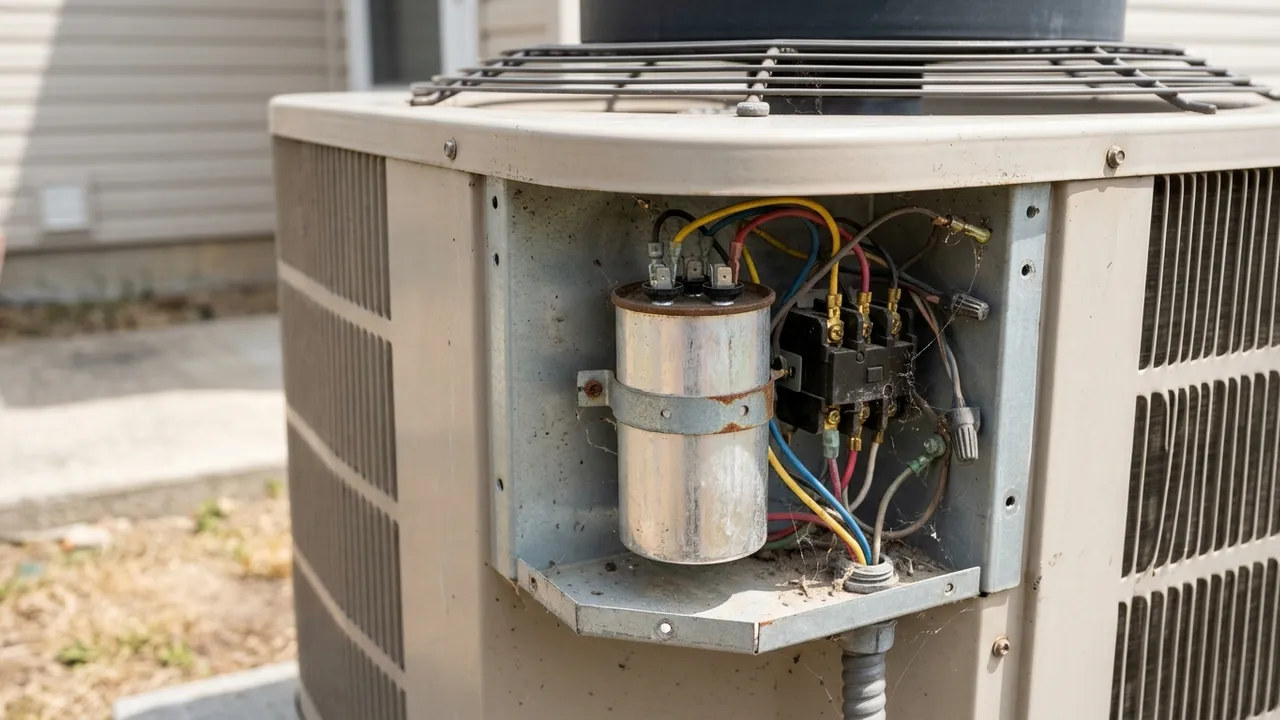
Many newer inducers don’t use a capacitor, but plenty of older ones do. It’s a small cylinder, usually silver or black, wired to the motor. When it fails, the motor hums and won’t start on its own. Sometimes it will start if you give it a spin.
If you see a swollen top, leaking oil, or a cracked case, it’s bad. Capacitors are cheap, but they can hold a charge even with the power off, so let a technician handle it unless you know how to discharge one safely.
Cause 8: Loose or burnt wiring
The plug that connects the inducer to the board takes a lot of heat over the years. Pins can loosen, and the plastic can get brittle or even melt a little.
With the power off, unplug it and look inside. Green corrosion, darkened pins, or melted plastic mean a poor connection. Sometimes cleaning and reseating it is enough. If the connector is burnt, it needs replacing, and you should check that the board terminal didn’t get damaged too.
If the inducer runs but the furnace still won’t light
Sometimes you’ll get the inducer running again and the furnace still won’t heat. That means the problem has moved further down the startup order:
- Igniter doesn’t glow: most furnaces use a hot surface igniter, a small flat element that glows bright orange. They’re brittle and crack with age. If you never see it glow, the igniter or its wiring is the usual suspect.
- Igniter glows but no flame: the gas valve isn’t opening. Check that the gas shutoff on the pipe going into the furnace is turned on (handle in line with the pipe). If it is, the valve or the board may be at fault, and that’s a job for a technician.
- Flame lights, then goes out after a few seconds: this is almost always a dirty flame sensor. It’s a thin metal rod sitting in the flame, and a light cleaning with fine steel wool often fixes it.
- Burners stay lit but no warm air comes out: the blower motor isn’t starting. Check the blower door switch and listen for the motor hum.
What to do in order (summary)
- Thermostat set to Heat, 5 °F above room temp, fresh batteries.
- Service switch on, breaker reset once.
- Door panel seated, door switch working.
- Board LED on? Check the fuse.
- Read the LED code. Look for a pressure switch fault.
- Power off, spin the inducer wheel by hand.
- Look at the wiring plug for damage.
- Test for 120 V at the inducer, or call a pro.
When to call a technician
Get a licensed HVAC technician out if the motor hums but won’t spin, the breaker or board fuse keeps tripping, the board shows a code you can’t clear, or you’re not comfortable testing for voltage. Also call if you notice any gas smell, scorch marks, or melted wiring. Those aren’t DIY situations.
If the motor needs replacing, ask for the exact OEM part number for your furnace. Universal inducers exist, but the motor speed and housing have to match what your pressure switch expects, or you’ll trade one problem for another.
Frequently asked questions
Can a furnace run without the inducer motor?
No. The inducer clears old gases out of the heat exchanger before every start. The pressure switch has to see that airflow before the board will turn on the igniter, so a dead inducer means no heat at all.
Why does my inducer motor hum but not spin?
A hum means the motor is getting power but can't turn. Seized bearings are the usual reason. Some older inducers also have a run capacitor that can fail and cause the same thing. Either way, the motor or capacitor needs replacing.
Can I tap the inducer motor to get it going?
Sometimes a light tap or a hand spin gets a sticky motor turning again, but only for a while. It's a sign the bearings are on their way out. Treat it as a short-term fix and plan to replace the motor.
How much does it cost to replace an inducer motor?
The part alone usually runs from about $150 to $500 depending on the furnace brand and model. With labor, most homeowners pay somewhere in the $400 to $900 range for a professional replacement.
How long should an inducer motor last?
Most last 10 to 15 years. Furnaces that run long seasons, or that pull in dusty or damp air, tend to wear them out sooner.
Did this guide fix your problem?
One tap helps us improve this guide for the next person.
Free maintenance reminders
Get a short email before summer and winter: filter changes, pre-season checks, and the problems to watch for. About 4 emails a year.